Laboratory Equipment - July 2010
Environmental & Field Testing
Vibration Isolation Faceoff
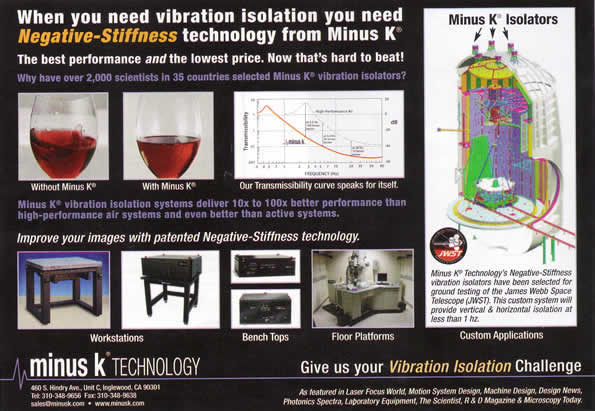
The use of air tables for vibration isolation is now being challenged by compact negative-stiffness vibration isolators.
By Jim McMahon
For almost forty years, pneumatic vibration isolators have been the mainstay for stabilizing industrial and academia's most critical micro-engineering instrumentation. But just as technology has been migrating from micro to nano, so has the need for more precise vibration isolation in microelectronics fabrication, industrial laser/optical systems and biological research.
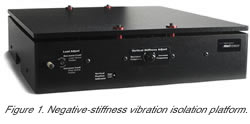 These so-called "passive system" air tables are now being challenged by the newer negative-stiffness vibration isolators because of their ability to effectively isolate vibration in diverse and challenging environments.
Air tables have been used since the 1960s. Basically cans of air, they are Still the most popular isolators used; but, with resonant frequencies at 2 to 2.5 Hz, they can only handle vibrations down to about 8 to 10 Hz -not quite low enough for optimum performance with modern nano-equipment. systems.
Also, greater isolation efficiencies are needed in the frequency ranges air isolators can handle. Negative-stiffness vibration isolation systems, on the other hand, enable vibration-sensitive instruments - scanning probe microscopes, micro-hardness testers, profilers and scanning electron microscopes - to operate in harsh conditions and severe vibration environments that would not be practical with top-performance air tables and other pneumatic isolation
How it works
Negative-stiffness isolators employ a unique, completely mechanical concept in low-frequency vibration isolation. A stiff spring provides vertical-motion isolation and supports a weight load, combined with a negative-stiffness mechanism. The net vertical stiffness is made very low without affecting the static load-supporting capability of the spring.
Beam-columns connected in a series with the vertical-motion isolator provide horizontal-motion isolation. The "beam-column" effect reduces the horizontal stiffness of the beam-columns, which behave as springs combined with a negative-stiffness mechanism.
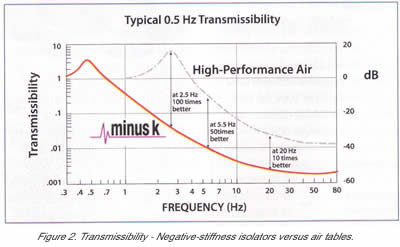
The resulting compact, passive isolator is capable of low vertical and horizontal natural frequencies and high internal structural frequencies. The isolators (adjusted to 0.5 Hz) achieve 93% isolation efficiency at 2 Hz, 99% at 5 Hz, and 99.7% at 10 Hz.
The benefits
The following ten key points demonstrate the benefits of negative-stiffness isolators compared to air isolation systems:
1. Low hertz perturbations: An air table amplifies vibrations in a typical range of 2 to 7 Hz because of the natural frequencies at which air tables resonate. All isolators amplify at their resonant frequency and then start isolating. Thus, with an air table, any vibration in that range not only fails to be mitigated but also amplified. The low cycle perturbations come straight through to the instrument.
Negative-stiffness isolators resonate at 0.5 H7 where almost no energy is present.
2. Image clarity: Negative-stiffness vibration isolation can reduce vibration noise levels in atomic force microscopes, for example, by a factor of 2 to 3 when compared with top-performance air tables. This is particularly significant for noise levels in the sub-Angstrom range and results in clearer images and features not discernible with pneumatic isolation systems.
 3. Severe vibration environments: As nano-equipment use becomes more prevalent, labs are being set up in more severe vibration-prone environments, such as upper floors of buildings and cleanrooms. Such locations are too extreme for pneumatic isolators to do their job effectively. Negative-stiffness isolators, however, perform well in such environments, producing better images and data.
4. Harsh environments: Air tables are not particularly compatible when operating in vacuums, extreme high and low temperatures and radiation. Yet these harsh operating environments are often necessary when conducting research and testing, such as with cryogenic chambers in semiconductor research.
All-metal negative-stiffness systems are compatible with high vacuums and other adverse environments, such as extreme high and low temperatures and radiation. With vacuums, for example, negative-stiffness isolators can be used right inside the vacuum chambers, offering other advantages such as lower payload weights and more compact systems. It also eliminates problems associated with vacuum chamber feed-through.
5. Compressed air: Air tables require a constant supply of compressed air from a dedicated compressed air line plumbed in to the lab, a tank of pressurized gas, or a small compressor.
Even if a lab has a dedicated compressed air line, the length of the line limits the table's location. Also, large tanks of compressed gas must be mounted securely to minimize their danger, and changing them can be difficult and inconvenient. As for compressors, they are sources of both mechanical and acoustic noise and are poor choices from a vibration standpoint.
Negative-stiffness isolators do not require compressed air. They operate in a mechanical mode, eliminating one more factor scientists have to worry about when setting up and working in the lab.
6. Location selection: Bulky air tables take up a lot of space, and high-performance air tables are even bigger. This can become limiting when laying out equipment in the lab.
Compact and easy to move around, negative-stiffness isolators are offered in high-performance benchtop configurations. They are also available as workstations, tables and floor platforms.
7. Load adjustment: Low-frequency passive vibration isolators are somewhat sensitive to small changes in weight loads, as well as to large displacements. Pneumatic systems utilize leveling valves to mitigate the problem.
Negative-stiffness isolators provide a simple manual adjustment to accommodate variations in weight loads. For applications where manual adjustment is not practical, they provide an auto-adjust system that maintains the isolator in a precise vertical equilibrium position.
8. Scanning probe microscopes: SPMs have vibration isolation requirements that are unparalleled in the metrology world. The vertical axis is the most sensitive for nearly all SPMs, and they can be sensitive to vibrations in the horizontal axes. In order to achieve the lowest possible noise floor, on the order of an Angstrom, isolation is always used.
Benchtop air systems provide limited isolation vertically and little isolation horizontally. Negative-stiffness isolators, however, offer the flexibility of custom tailoring resonant frequencies vertically and horizontally.
9. Laser/optical equipment: Laser and optical systems, whether used in an academic lab or industrial environment, are susceptible to vibrations from the environment and thus usually require vibration isolation. Negative-stiffness isolators provide 10 to l00x the performance of air tables, depending on the vibration frequency.
Laser-based interferometers are capable of resolving nanometer-scale motions and features, and they often have long mechanical paths that make them extremely sensitive to vibrations. The sophisticated, modern ellipsometry techniques that allow this high performance rely on low noise to detect fringe movement. Properly isolating an interferometer allows it to provide the highest possible resolution.
Optical profilers have similar sensitivity to vibrations. Optical component systems are often quite complex, and the long optical paths can lead to angular magnification of vibrations. Optical air tables can make the problem worse because their resonant frequency often matches that of floor vibrations. Negative-stiffness 0.5-Hz isolators provide isolation in these environments where air tables simply cannot.
10. Maintenance and expense: Negative-stiffness isolators utilize simple elastic structures and viscoelastic materials that deform. Thus, their isolation performance does not degrade with the micromotions typical of laboratory floors and fabrication rooms, as do conventional pneumatic isolators.
Regarding cost, negative-stiffness isolators are comparably priced to air isolators or lower priced for many applications.
For more information, contact Steve Varma, Minus K Technology, Inc., at 310-348-9656 or sales@minusk.com. Minus K Technology, Inc. develops and manufactures advanced vibration isolation products based on the company's patented negative-stiffness-mechanism technology.